
Photo: Rashid Tajuar, Unsplash
 Faculty of Law, Department of Digital and Technology Lawajk.kre.hu
Speaking & Teaching · University
Introduction to the application of AI.
How it works, what it is good for, where it goes wrong, and what the law does with it. Slides and study material from the correspondence-course day.
- Dr. János Kopasz
- visiting lecturer, Department of Digital and Technology Law
- Course
- Introduction to the application of AI, correspondence course
- Date
- 10 October 2026
- Faculty
- Károli Gáspár University of the Reformed Church in Hungary, Faculty of Law
Slides
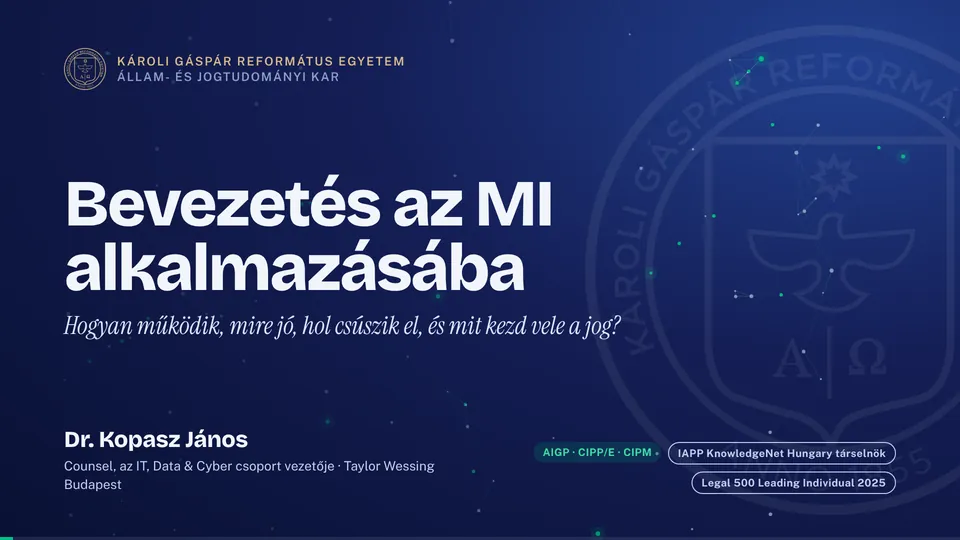 Start the slides (76 slides)
Bevezetés az MI alkalmazásába
Open in a new tab (opens in a new tab)Notes (PDF) (opens in a new tab)
A first map of AI for future lawyers.
On 10 October 2026 I spent the day with first-year law students in the correspondence programme of the Faculty of Law of Károli Gáspár University of the Reformed Church in Hungary. The course went from how AI works and how it developed to what it changes, how the law answers it in the AI Act, and how to use it in study and legal work under the university’s own rules. It closed with prompting and with the semester assignment, an AI policy for an organisation of the student’s choice.
The question running through the day: if AI decides, who is responsible? The answer is always a person or an organisation. So every block came back to the same habits: understand how the system works, check its output against the original source, and document how AI was used.
The study notes are in Hungarian, on the study page and in the PDF; this page gives an English outline of the day.
The arc of the day.
Between a short opening (slides 1 to 7) and the close (slides 73 to 76), the day ran in seven blocks.
- 01How AI works
From the artificial neuron to large language models: how machines learn from examples, why fluent text is not the same as true text, and how the AI Act defines an AI system.
- 02History
Waves of promise and disappointment from the Dartmouth workshop to the ChatGPT moment and the 2024 Nobel Prizes, and where AI is used today.
- 03Impacts
Benefits and risks side by side: hallucination and the sanctions in Mata v. Avianca, bias, deepfakes, data and copyright, and the idea of a robot judge.
- 04The law’s answer: the AI Act
The risk-based logic of the AI Act, its prohibitions and timeline, a worked case on admission essays, and the other rules that apply alongside it.
- 05AI in practice
Choosing tools by purpose, learning with AI the right way, the university’s rules on AI use, and why a person checks every stage of AI-assisted legal work.
- 06Prompting
The anatomy of a good prompt, the main types of prompt, and a bad prompt set against a good one.
- 07Semester assignment: AI policy
An AI policy for an organisation of the student’s choice, built in seven steps on a ten-chapter outline.

Dr. János Kopasz
Counsel, Head of the IT, Data & Cyber practice · Taylor Wessing Budapest
Advice on AI, data protection and cybersecurity law for companies.
- IAPP
- AIGP, CIPP/E, CIPM
Content
This page holds the teaching material of the class on 10 October 2026: general information, not legal advice on any individual matter. Legal deadlines and figures reflect the position in October 2026. Slide numbers follow the deck as shown in class; slides 36, 54 and 64 were breaks and are left out here.
Use of AI
I also used AI-based tools to prepare the class material and this page. Every text and image was checked and edited by a person, and I am responsible for the content.
Reuse
You are free to use it for your own study. Short excerpts may be quoted with the source named; the material as a whole, or a substantial part of it, may not be published elsewhere without prior permission.
University
The slides appear here in the form shown on a course at Károli Gáspár University of the Reformed Church in Hungary. This is the lecturer’s own page, not an official university channel; always apply the university’s rules from their official text.
Portrait: Taylor Wessing